
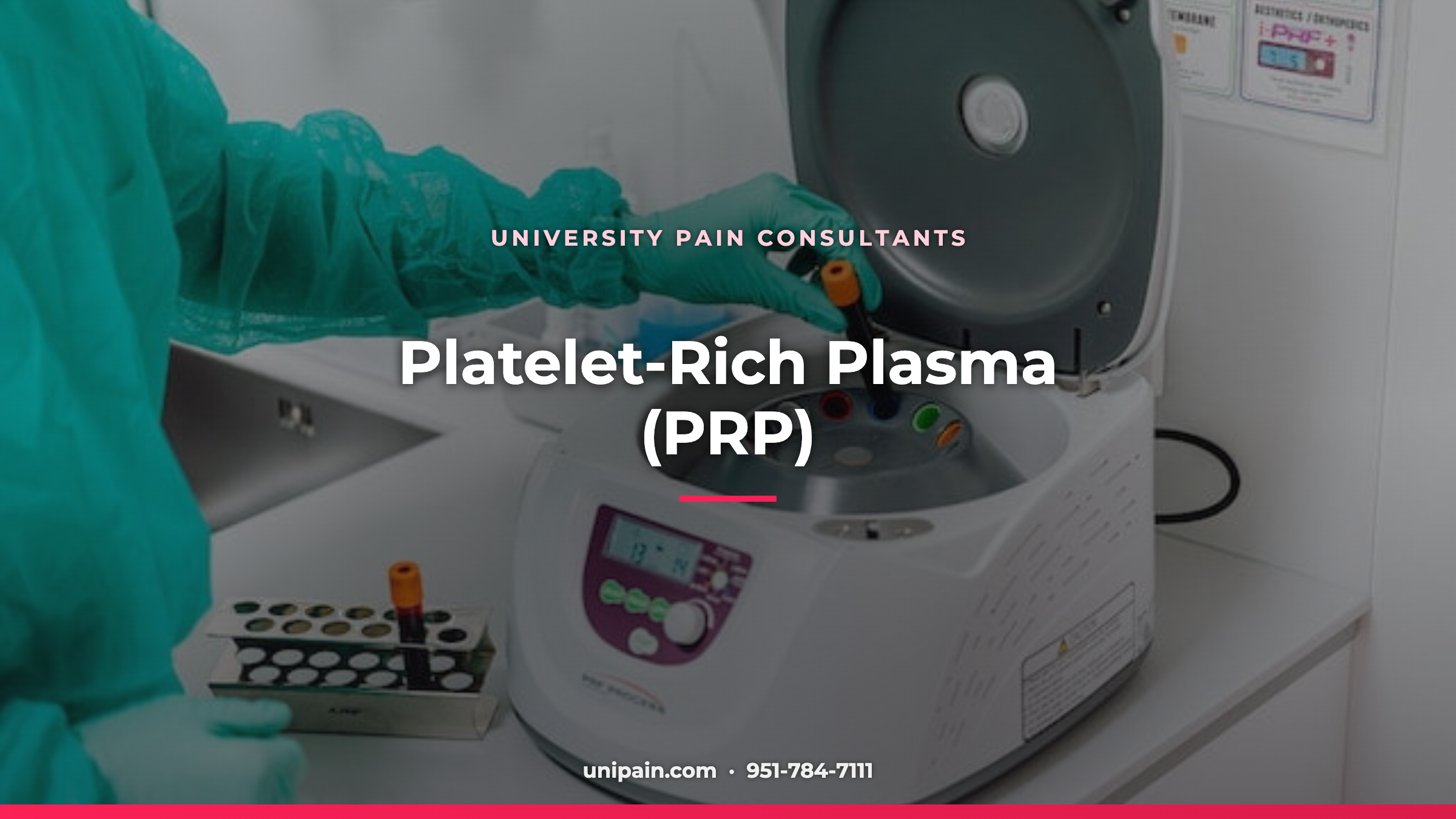
Advanced regenerative treatment for pain relief and healing. At University Pain Consultants in Riverside, we use platelet-rich plasma (PRP) therapy as a natural, minimally invasive way to relieve chronic pain. Platelet-rich plasma uses your body’s own healing factors to repair damaged tissue, reduce inflammation, and restore function — often with longer-lasting relief than traditional steroid injections.
What is platelet-rich plasma (PRP)?
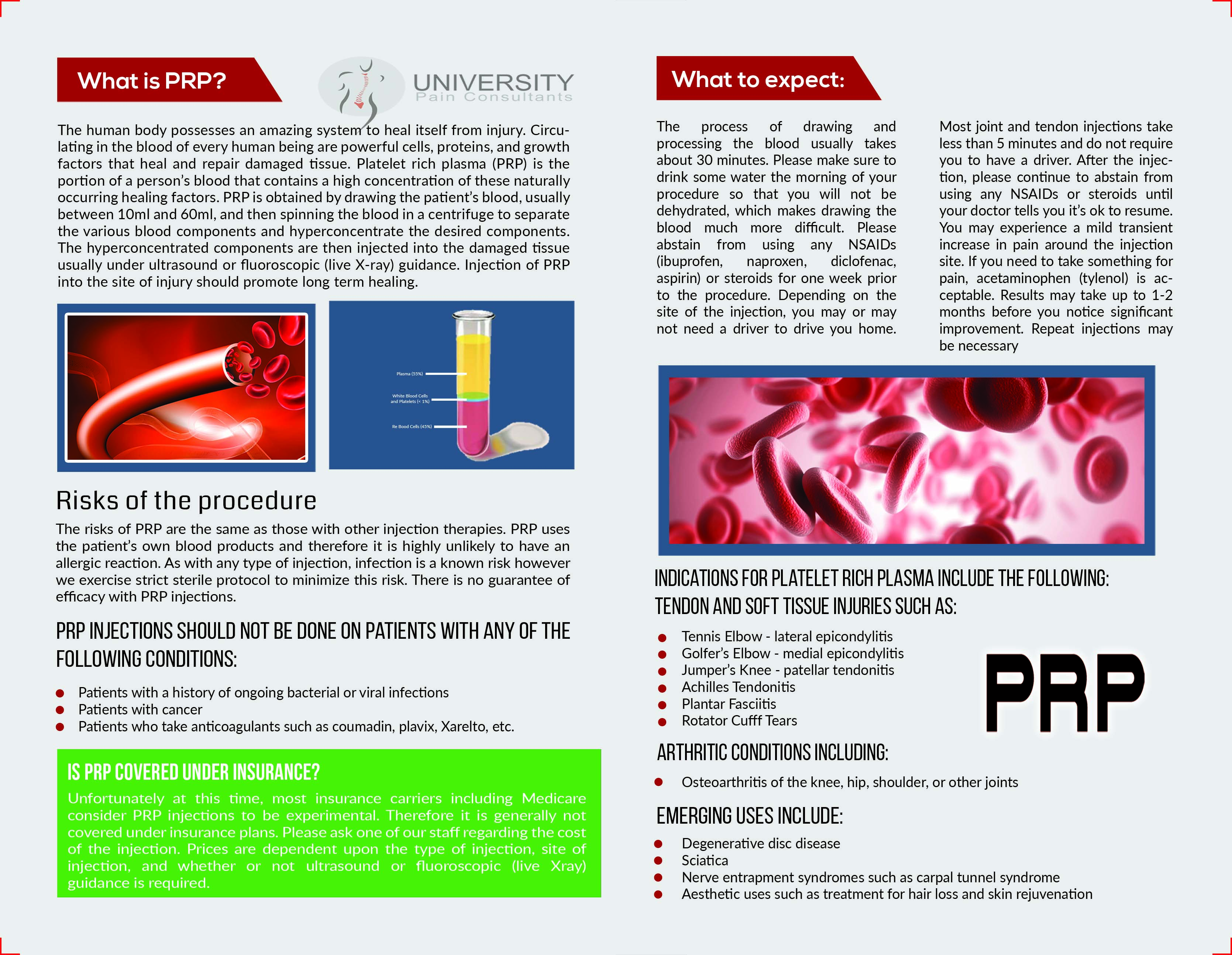
Platelet-rich plasma is a concentrated form of your own blood plasma that is rich in platelets and powerful growth factors. These growth factors are the same signals your body uses to heal an injury — they stimulate cell regeneration, collagen production, and tissue repair. Because PRP is made entirely from your own blood, it is autologous, which means a very low risk of allergic reaction.
How PRP therapy works
Creating and delivering platelet-rich plasma is a straightforward, in-office process. First, we draw a small sample of your blood, much like a routine lab test. That sample is spun in a high-quality centrifuge using a double-spin technique to concentrate the platelets. Finally, the PRP is injected precisely into the damaged area using ultrasound or fluoroscopic (X-ray) guidance for maximum accuracy. The entire procedure is performed in our office and usually takes 30 to 60 minutes.
Conditions we treat with platelet-rich plasma
We tailor each treatment to your specific pain generator. Platelet-rich plasma injections can help with a wide range of spine and musculoskeletal problems.
Spine and back pain
- Lumbar disc pain (intradiscal PRP)
- Radicular pain and sciatica (epidural PRP)
- Facet joint syndrome
- Sacroiliac (SI) joint pain and dysfunction
Because it supports disc and joint health, PRP is sometimes considered alongside other care for degenerative disc disease.
Joint, tendon, and soft-tissue pain
- Knee, hip, shoulder, and other large-joint osteoarthritis
- Rotator cuff injuries and tendinopathies
- Tennis elbow, golfer’s elbow, plantar fasciitis, and Achilles tendinopathy
- Ligament, tendon, and chronic soft-tissue injuries
Benefits of platelet-rich plasma therapy
For the right patient, platelet-rich plasma offers several advantages over conventional injections:
- Uses your own biological material, so the risk of allergic reaction is very low
- Minimally invasive, with little to no downtime
- May provide longer-lasting relief than corticosteroid (cortisone) injections
- Promotes natural healing rather than simply masking pain
PRP vs. cortisone injections
Cortisone injections reduce inflammation quickly, but the relief is often temporary, and repeated steroid injections can weaken tissue over time. Platelet-rich plasma works differently: instead of masking pain, it delivers growth factors that encourage the body to repair the underlying problem. For many people with osteoarthritis or tendon injuries, that means the potential for more durable, natural relief. You can read an independent overview of PRP from the American Academy of Orthopaedic Surgeons.
What to expect after your PRP treatment
Because PRP kick-starts a natural healing response, mild soreness at the injection site for a few days is normal and usually a good sign. Most people return to everyday activities right away and gradually improve over several weeks as the tissue repairs. Your provider may recommend combining PRP with physical therapy or other chronic pain treatments for the best results.
Is platelet-rich plasma right for you?
Platelet-rich plasma is a strong option for many people with osteoarthritis, tendon injuries, or chronic spine pain that has not responded to rest, medication, or physical therapy. It may not be appropriate if you have an active infection, certain blood or platelet disorders, or are pregnant. The best way to know is a consultation, where we review your history and imaging and pinpoint the exact source of your pain.
Frequently asked questions
Does PRP therapy hurt?
Most patients tolerate platelet-rich plasma injections well. You may feel brief pressure during the injection and some soreness afterward, which typically eases within a few days.
How many PRP sessions will I need?
It depends on your condition and goals. Some people do well after a single treatment, while others benefit from a short series of injections spaced a few weeks apart.
How soon will I see results?
PRP works gradually. Many patients begin to notice improvement within a few weeks, with continued gains over two to three months as healing progresses.
Is platelet-rich plasma safe?
Because PRP is made from your own blood, it is very safe, with a low risk of allergic reaction. Your provider will review your health history to confirm you are a good candidate.
Looking for PRP specifically for knee or shoulder pain in Riverside? See our cash-pay Regenerative Medicine pages: PRP for knee pain · PRP for shoulder pain. Regenerative Medicine at UPC is cash-pay (superbill available); call 951-900-3253.
Ready to find out whether platelet-rich plasma is right for you? Call University Pain Consultants at (951) 784-7111 or visit our locations page to request a consultation in Riverside or Menifee.

Recommended Videos on PRP
Other PRP services we offer
***Platelet Rich Fibrin (PRF) is also available upon request.***
-
Sacroiliac Joint Injection: Why Fluoroscopic Guidance Matters for SI Joint Pain
Read more: Sacroiliac Joint Injection: Why Fluoroscopic Guidance Matters for SI Joint PainA fluoroscopically guided sacroiliac joint injection is the most accurate way to diagnose and treat SI joint pain. Dr. Rainier Guiang, MD explains how it works.
-
How Smoking Speeds Up Degenerative Disc and Joint Disease
Read more: How Smoking Speeds Up Degenerative Disc and Joint DiseaseSmoking and degenerative disc disease are closely linked. Dr. Rainier Guiang, MD explains how cigarettes starve your spine and joints — and why quitting helps.
-
Closed-Loop Stimulation: The Next Step in Spinal Cord Stimulation Technology
Read more: Closed-Loop Stimulation: The Next Step in Spinal Cord Stimulation TechnologySpinal cord stimulation has helped many people manage chronic pain that didn’t respond to other treatments. But traditional systems have always had one built-in limitation: they deliver a fixed level of stimulation, regardless of what’s actually happening inside the body from moment to moment. Closed-loop stimulation was developed to solve that problem — and it’s…
-
Red Light Therapy for Chronic Pain: What the Evidence Actually Says
Read more: Red Light Therapy for Chronic Pain: What the Evidence Actually SaysA pain physician’s honest, evidence-based look at red light therapy (photobiomodulation) for neck, knee, back, fibromyalgia & nerve pain.
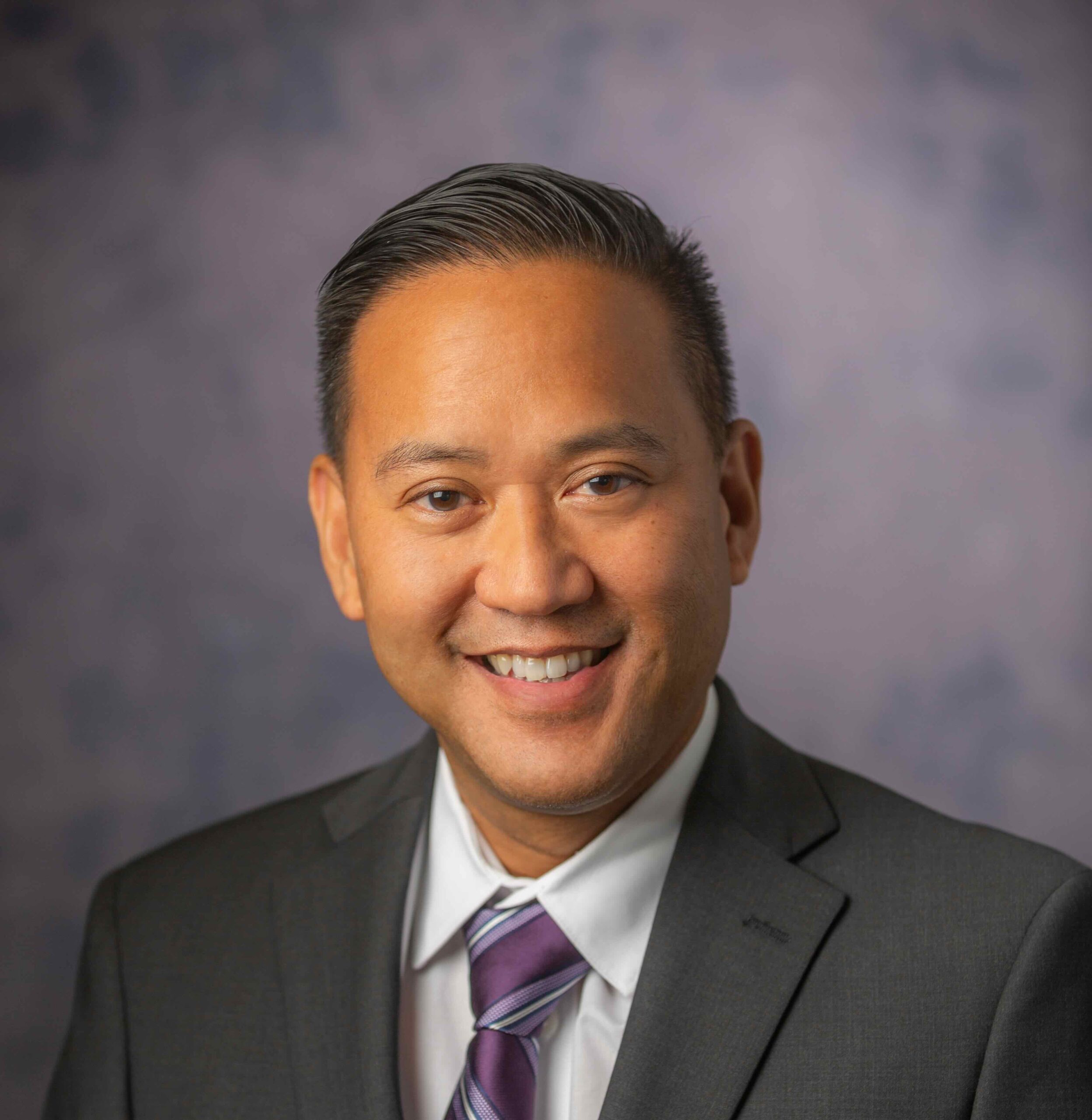
Rainier Guiang, MD
Dr. Rainier Guiang co-founded University Pain Consultants in 2007 and is double board-certified in anesthesiology and pain management through the American Board of Anesthesiology. He previously served as co-director of the ACGME-accredited pain management fellowship at University Hospitals of Cleveland / Case Western Reserve University School of Medicine, and has authored chapters in Weiner’s Pain Management. He has a strong interest in interventional, functional, and preventive approaches to chronic pain.