
Sciatica Treatment in Riverside & the Inland Empire
Sciatica is pain that travels from the low back or buttock down the leg — often with tingling, numbness, or burning. Most of the time it comes from irritation of a lumbar nerve root (lumbar radiculopathy), commonly from a herniated disc or spinal stenosis. At University Pain Consultants, we build a plan that usually starts with conservative care and medications, then adds image-guided injections when nerve inflammation is still driving symptoms. Care is available in Riverside, Corona, Menifee, Temecula, Hemet, and San Bernardino.
Call 951-784-7111 · Choose your location
Offices: Riverside · Corona · Menifee · Temecula · Hemet · San Bernardino
What sciatica usually means
Patients say “sciatica” when pain shoots into the leg. Clinically we ask whether that pattern matches a pinched or inflamed spinal nerve root. Typical clues:
- Pain below the knee or into the foot
- Worse with sitting, coughing, or sneezing
- Numbness, tingling, or weakness in a nerve-root pattern
Not all buttock or thigh pain is true radiculopathy. Hip joint problems, sacroiliac (SI) joint pain, and piriformis-related pain can mimic sciatica. A focused exam — and imaging when needed — keeps treatment pointed at the real driver.
Common causes we evaluate
- Herniated or bulging disc irritating a nerve root
- Spinal stenosis crowding nerves in the canal or foramina
- Degenerative disc or bone-spur contact with a nerve
- Spondylolisthesis when slippage adds nerve irritation
- Post-surgical nerve pain in selected patients
- Less often: infection, fracture, or tumor — screened when red flags appear
Step 1: Conservative therapy (where most plans start)
For many people, sciatica improves over weeks to a few months with structured non-surgical care. We coordinate or encourage:
- Physical therapy — nerve-friendly mobility, core and hip strength, walking progression, and education on positions that calm symptoms (and which movements to modify early on)
- Activity modification — stay moving within limits; long bed rest usually makes recovery harder
- Chiropractic care — some patients benefit from skilled spinal manipulation or mobilization as part of a broader plan, especially for mechanical back pain that travels into the leg; we discuss fit case by case and prefer providers who communicate with the medical team
- Osteopathic or manual therapy — similar role when appropriate
- Acupuncture — an option some patients use for pain modulation alongside medical care
- Heat or ice, pacing, and ergonomics — practical supports for sitting, driving, and work
- Home exercise — once symptoms allow; viral “instant fix” stretches are not a substitute for evaluation if pain is severe, progressive, or neurologic
Conservative care is not “doing nothing.” It is the foundation — and it is what injections are meant to support when inflammation blocks progress.
Step 2: Medications commonly used for sciatica
Medications do not fix a disc, but they can lower pain enough to sleep, walk, and do therapy. Choices are individualized (kidney/liver status, age, interactions, and prior response matter):
- NSAIDs (for example ibuprofen or naproxen, when safe) — reduce inflammation and musculoskeletal pain
- Acetaminophen — for patients who cannot take NSAIDs, within safe daily limits
- Neuropathic agents — gabapentin or pregabalin are often used for burning, shooting, or tingling nerve pain
- SNRIs (such as duloxetine) — can help chronic nerve-related pain and mood overlap when appropriate
- Muscle relaxants — short courses for muscle spasm; not a long-term solution alone
- Short oral steroid bursts — sometimes used for acute severe radiculopathy; not for everyone
- Topicals — lidocaine or other topicals for localized sensitivity
- Opioids — not first-line for routine sciatica; if used at all, typically brief and closely supervised
We avoid stacking sedating medicines casually and reassess if pills are the only thing “working.” Medication is a bridge, not the whole plan.
Step 3: Interventional procedures we offer
When leg-dominant nerve pain stays high despite conservative care — or is so severe you cannot progress — image-guided procedures can target the inflamed nerve root or related structures.
Epidural steroid injection (ESI)
The most common interventional step for true sciatica. Under fluoroscopy (live X-ray), anti-inflammatory steroid is placed in the epidural space near the irritated nerve root — interlaminar, transforaminal, or caudal depending on anatomy. Goal: calm inflammation so PT and time can work. See our dedicated page: lumbar epidural steroid injection.
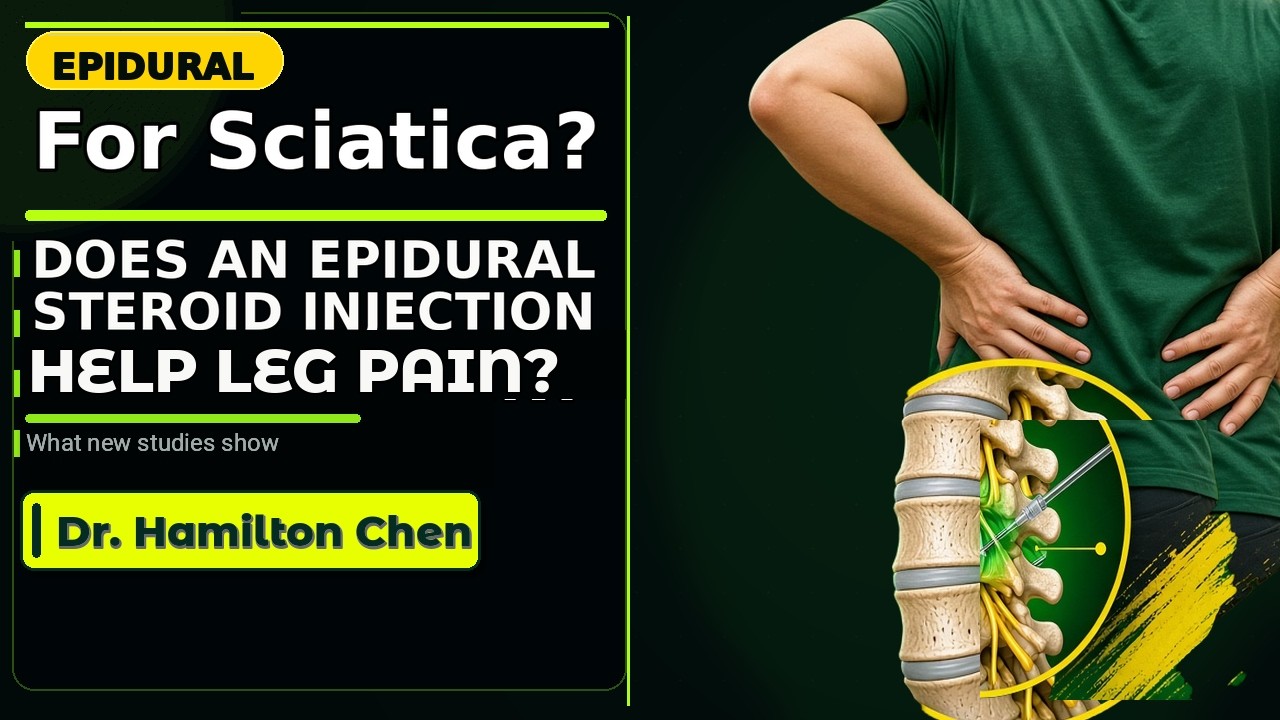
Watch on YouTube · Dr. Hamilton Chen, University Pain Consultants — Epidural Steroid Injection for Sciatica
Selective nerve root / transforaminal approaches
When one root is clearly involved, a targeted foraminal approach can deliver medication close to that root and, in selected cases, help confirm the pain generator.
When the “sciatica” is not only a disc
- SI joint injection — if exam suggests sacroiliac referral into the buttock/leg
- Facet injection / medial branch blocks — if axial back pain dominates and facets are the driver
- Radiofrequency ablation — after positive medial branch blocks for facet-mediated pain (not a first treatment for classic disc sciatica)
Spinal cord stimulation
For selected patients with persistent radicular or neuropathic leg pain after appropriate injections, therapy, and (when relevant) surgery discussion — especially persistent pain after spine surgery — a spinal cord stimulator trial may be considered. This is not the starting point for new, uncomplicated sciatica.
How we decide the order of care
- Confirm the pattern — radiculopathy vs mimic (hip, SI, peripheral nerve)
- Rule out red flags — see below
- Optimize conservative care + appropriate medications
- Add ESI when inflammation is still limiting recovery
- Escalate or redirect — different injection target, RFA for facet pain, stimulator discussion, or surgical referral when indicated
Red flags — seek urgent care
- New bowel or bladder incontinence or retention
- Saddle anesthesia (numbness in the groin/perineum)
- Rapidly progressive leg weakness
- Fever with severe back pain, or pain after major trauma
- Unexplained weight loss or history that raises concern for infection or cancer
Those situations are not “wait for an elective injection” problems.
What to expect at University Pain Consultants
- Consult — history, neurologic exam, review of MRI/X-ray when available
- Shared plan — PT, medications, and whether an epidural is appropriate now or later
- Procedure visits — outpatient, fluoroscopy-guided when injecting; clear after-care instructions
- Follow-up — measure response; do not repeat procedures that are not helping
Insurance and scheduling
Insurance-based care: University Pain Consultants accepts most major plans at all six locations. Authorization rules for ESI and advanced procedures vary by insurer; our staff helps verify benefits when possible. Call 951-784-7111.
Cash-pay regenerative options are separate at upcregenmed.com and are not a substitute for standard sciatica pathways on this page.
Serving Riverside and the Inland Empire
Our Riverside office is at 6900 Brockton Ave. #203, Riverside, CA 92506. Many patients also choose Corona, Menifee, Temecula, Hemet, or San Bernardino for drive time. We also see patients from Moreno Valley, Murrieta, Perris, Lake Elsinore, Wildomar, Norco, Eastvale, Redlands, Rialto, Colton, Fontana, and Yucaipa.
Six University Pain Consultants locations
- Riverside — 6900 Brockton Ave. #203, Riverside, CA 92506
- Corona — 2083 Compton Ave. #104, Corona, CA 92881
- Menifee — 27990 Sherman Road, Menifee, CA 92585
- Temecula — 27450 Ynez Road #202, Temecula, CA 92591
- Hemet — 3989 West Stetson Ave. #102, Hemet, CA 92545
- San Bernardino — 164 West Hospitality Lane #5, San Bernardino, CA 92408
Main: 951-784-7111 · Fax: 951-823-5000 · All locations & maps
FAQ
Will sciatica go away on its own?
Many cases improve over weeks to months with conservative care. Severe, progressive, or neurologic symptoms need a faster workup.
Do I need an MRI before treatment?
Not always on day one. Imaging is more important if symptoms persist, worsen, or procedures are planned.
Is chiropractic OK for sciatica?
For some mechanical presentations, yes as part of a coordinated plan. It is not appropriate for every cause (for example, unstable neurologic deficits). Tell us who you are seeing so care stays aligned.
When do you recommend an epidural?
Typically when leg-dominant nerve pain remains significant after a reasonable conservative trial — or sooner when pain severity blocks any progress and the exam/imaging fit radiculopathy.
Can medications alone cure sciatica?
Usually no. They reduce symptoms while the nerve calms and you rebuild function.
What if injections do not help?
We reassess the diagnosis, consider other targets, discuss advanced options such as a stimulator trial in selected chronic cases, or involve spine surgery when indicated.
Ready to build a sciatica plan at a UPC office near you?
Call 951-784-7111 · Choose your location
Offices: Riverside · Corona · Menifee · Temecula · Hemet · San Bernardino
Educational information only — not personal medical advice. Individual results and risks vary. Ask your physician whether a given treatment is appropriate for you.
Related: Lumbar epidural · Cervical epidural · SI joint injection · Facet / medial branch blocks · Radiofrequency ablation · Spinal cord stimulator