
Spinal Cord Stimulator in Riverside & the Inland Empire
A spinal cord stimulator is for chronic back and leg pain that has already been through simpler care. It sends electrical pulses near the spinal cord to change how that pain is felt. University Pain Consultants starts with a temporary trial. A permanent implant comes later, and only if the trial helps, in Riverside, Corona, Menifee, Temecula, Hemet, and San Bernardino.
Call 951-784-7111 · Choose your location
Offices: Riverside · Corona · Menifee · Temecula · Hemet · San Bernardino
Also see: what spinal cord stimulation is, stimulation for chronic sciatica, and closed-loop stimulation.
Who a spinal cord stimulator is for
Chronic pain after therapy, medication, and injections have fallen short:
Back and leg pain that continues after spine surgery (sometimes called failed back surgery syndrome)
Neuropathic leg pain, including long-standing sciatica
Pain when another operation is not the next step
Other nerve-pain problems already on our SCS pages, including complex regional pain syndrome and diabetic neuropathy, after an individual review
Evaluation reviews prior care and imaging and typically includes a psychological evaluation before a permanent device. It is not a cure, and it does not help everyone.
The practice’s board-certified physicians include physicians experienced in spinal cord stimulation — Drs. Chen, Guiang, Hyun, and Pang. No single physician does every trial or implant.
Who should start somewhere else
New sciatica or a recent disc problem. Start with a lumbar epidural, not a stimulator. New neck and arm pain starts with a cervical epidural.
Ache with arching, twisting, or standing, usually not past the knee. That path is medial branch blocks, then lumbar RFA if the blocks agree. Neck facets: cervical RFA. Both regions: RFA overview.
Buttock or hip pain that fits the sacroiliac joint
Active infection, an unchecked bleeding risk, or another implant (such as a pacemaker) not yet reviewed
Untreated psychiatric illness — our sciatica page notes stimulation is not recommended then
New weakness or a bowel or bladder change. That needs urgent evaluation, not a device visit
What it is, in plain language
Thin leads sit near the spinal cord. A pulse generator (battery and electronics) powers them. Pulses are meant to quiet pain signals. The device does not remove a disc, clear scar, or straighten the spine, and it is not open back surgery. If it stops helping, it can in most cases be reprogrammed or removed. Removal is still a procedure.
Some programs feel like mild tingling. Newer waveforms are often sub-perception — little or nothing felt. High-frequency, burst, and dorsal root ganglion stimulation may be discussed. Closed-loop systems adjust as posture changes. The trial helps decide. No one system fits every person.
Trial first, implant only if it helps
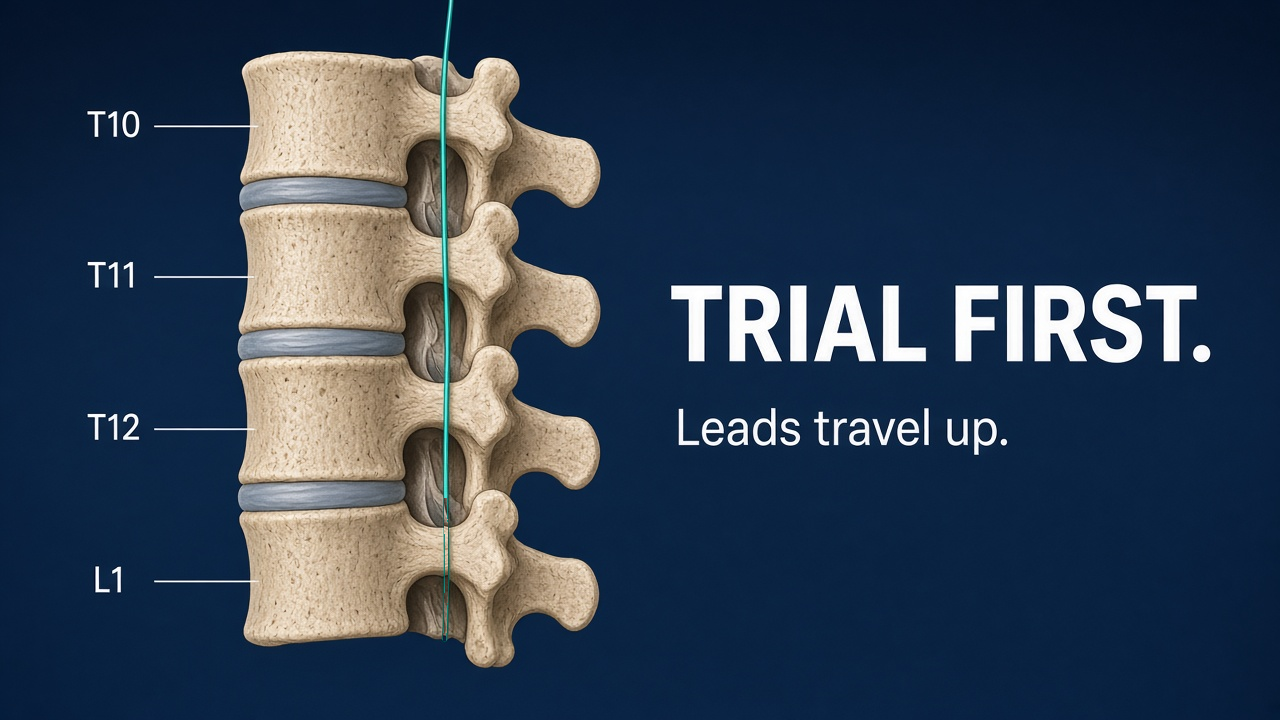 Trial. Leads are placed near the spinal cord and connected to a generator you wear outside the body. You keep a pain and function diary. A later implant depends on a meaningful drop in leg and back pain and a more usable day. How much it helps varies.
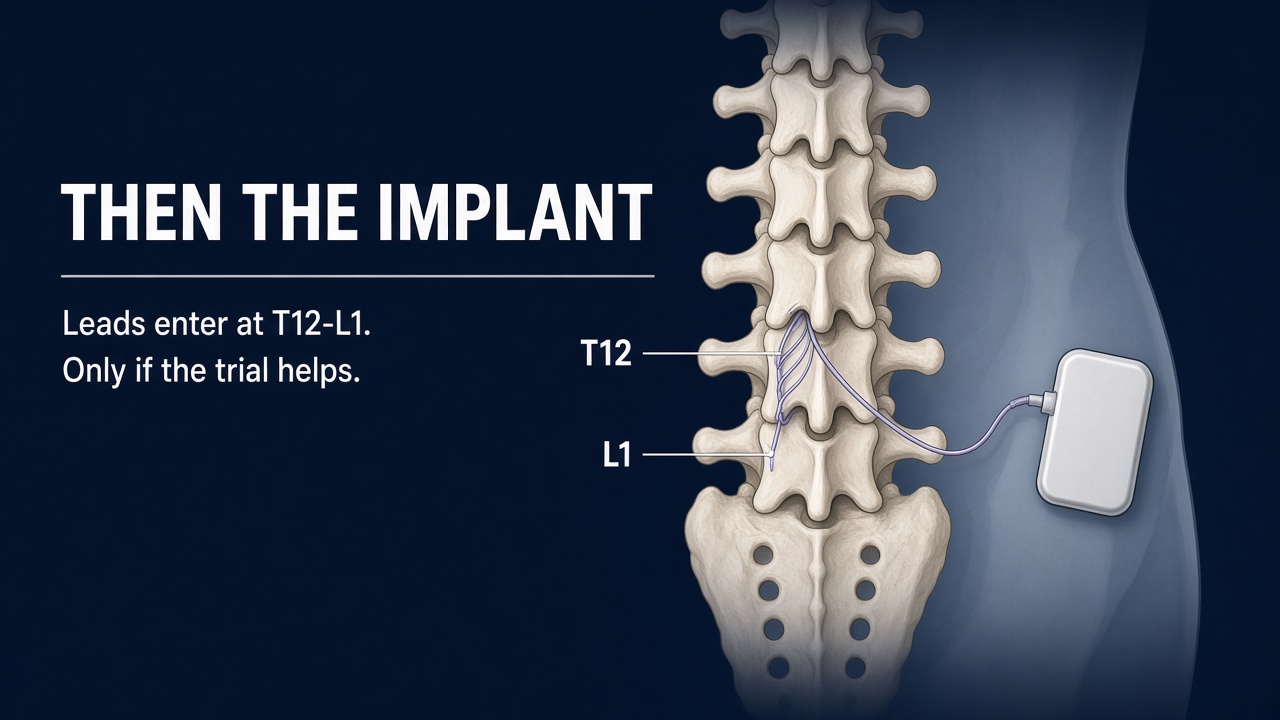 Implant. A separate day, only if the trial helped. The permanent generator goes under the skin, commonly in the buttock or abdomen, and connects to the leads. If the trial does not help enough, the temporary leads come out and nothing stays in.
What the trial period is like
Our guide describes a trial of several days to a couple of weeks. Your dates are set at scheduling, not copied from a brochure.
You go home with the battery outside the body, secured so you can move.
Dressings stay on. Instructions commonly limit bending, twisting, heavy lifting, and soaking the site so leads are less likely to move. Follow the sheet you are given.
Log pain and what you could do — walk, sit, stand, sleep — and bring the diary back.
Settings can be changed if coverage is too strong, too faint, or in the wrong place.
At the end, leads are removed unless you are going on to an implant.
What implant day is like
Only after a helpful trial. Placement is typically done with local anesthetic and light sedation. Sedation means a driver that day. The generator is placed under the skin and connected to the leads. Incisions are closed. Programming is not finished in recovery. Later visits tune coverage to the painful area.
Recovery, without a guaranteed calendar
People differ. What follows is common, not a schedule we guarantee.
Incisions
Soreness for about a week or two is common.
Early weeks
Most people limit bending, twisting, and heavy lifting while incisions heal and leads settle.
Programming
Expect changes once you are walking more.
Later
After your physician clears you, most everyday activity can usually resume. Contact sports and some security scanners need device-specific advice.
Some people later use less pain medication. Many do not. Changes are made with the prescriber. A generator replacement is sometimes needed after several years, not on a fixed date.
Call for fever, a wound that looks infected, new weakness, or bowel or bladder change.
Risks
Infection. Bleeding. Leads that migrate, so stimulation misses the pain. A revision, repositioning, or removal. A device that does not help, including a trial that looked better than life with the implant. Allergy and nerve irritation are discussed even when uncommon. Blood thinners, diabetes, other implants, and past infection are reviewed first. Do not stop a blood thinner on your own.
Insurance
Insurance-based care at all six offices. A trial, and a later implant, usually needs authorization. Plans often want notes on therapy, medication, injections, imaging, and the psychological evaluation. Staff verify benefits when they can. Authorization is not the same as payment. Call 951-784-7111.
Cash-pay regenerative care is separate at upcregenmed.com and is not part of this procedure.
Riverside and the other five offices
Riverside is 6900 Brockton Ave. #203, Riverside, CA 92506. Corona, Menifee, Temecula, Hemet, and San Bernardino are the same practice when the drive is shorter.
Six University Pain Consultants locations
Riverside
6900 Brockton Ave. #203, Riverside, CA 92506
Corona
2083 Compton Ave. #104, Corona, CA 92881
Menifee
27990 Sherman Road, Menifee, CA 92585
Temecula
27450 Ynez Road #202, Temecula, CA 92591
Hemet
3989 West Stetson Ave. #102, Hemet, CA 92545
San Bernardino
164 West Hospitality Lane #5, San Bernardino, CA 92408
Main: 951-784-7111 · Fax: 951-823-5000 · All locations & maps
FAQ
What is the difference between a stimulator trial and a permanent implant?
The trial uses temporary leads and an external generator for ordinary days at home. The implant places the generator under the skin, and only if the trial helped. They are separate procedures. A failed trial leaves no hardware behind.
Does placement hurt?
The skin is numbed. The implant is typically done with light sedation and local anesthetic. Pressure is common, and incision soreness for about a week or two is common. Speak up if pain shoots down the leg.
Will I feel shocks?
Some programs cause a mild tingling over the painful area. Many newer waveforms are sub-perception, so you feel little or nothing while they run. A harsh shock is not the goal. Settings can be changed during the trial and after the implant.
Can I get an MRI with a spinal cord stimulator?
It depends on the device. Ask the team, and bring the device card, before any scan. We do not claim every stimulator is MRI-safe. Some security scanners need the same kind of check.
How long does the trial last?
Several days to a couple of weeks, the range in our patient guide. Your dates are set individually, long enough to judge walking, sitting, and sleep.
Does insurance cover a spinal cord stimulator?
Often, if plan rules are met and authorization is approved. Trial and implant usually each need it. Staff verify benefits. Call 951-784-7111. Scheduling approval is not a promise of payment.
Can I drive?
If sedation is used — typical for the implant — you need a driver that day. The trial follows the same rule. The office confirms before you come. Later driving follows the limits you were given.
What if the trial does not help?
Temporary leads come out. That result argues against an implant. Next steps may be a lumbar epidural, lumbar RFA if facets are the driver, or care without a device. A poor trial is not a reason to implant anyway.
Ready to talk about a stimulator trial near you?
Call 951-784-7111 · Choose your location
Offices: Riverside · Corona · Menifee · Temecula · Hemet · San Bernardino
Ready to find relief?
Educational information only — not personal medical advice. Individual results and risks vary. Ask your physician whether this treatment is appropriate for you.
Related: Lumbar epidural · Cervical epidural · Lumbar radiofrequency ablation · Cervical radiofrequency ablation · SI joint injection · Facet / medial branch blocks · RFA overview