
A sacroiliac joint injection is one of the most useful tools in pain medicine, and one of the most misunderstood. If your low back pain sits below the belt line, stays mostly on one side, and has not responded to physical therapy or medication, your sacroiliac (SI) joint may be the source. At University Pain Consultants in Riverside, every sacroiliac joint injection is performed under live X-ray guidance called fluoroscopy, because that is the only reliable way to know the medication actually reached the joint.
What the sacroiliac joint is, and why it hurts
You have two sacroiliac joints, one on each side, where the triangular sacrum at the base of your spine meets the iliac bones of your pelvis. They are built for load transfer rather than movement: thick ligaments hold them together while the weight of your upper body passes through them with every step. They also carry a rich nerve supply, which is why an irritated SI joint can produce a deep ache that is surprisingly hard to point to.
Research suggests the SI joint is the pain generator in roughly 15% to 30% of people with chronic low back pain that does not radiate down the leg (Cohen et al., Expert Review of Neurotherapeutics). Common contributors include pregnancy, a fall onto the buttock, a motor vehicle accident, leg-length differences, inflammatory arthritis such as ankylosing spondylitis, and previous spine surgery. In one study, SI joint degeneration was present in 75% of patients five years after lumbar fusion, compared with 38% of age-matched controls.
Signs your low back pain may be coming from the SI joint
SI joint pain has a recognizable pattern, even though it overlaps with disc and facet problems. Before we consider a sacroiliac joint injection, we listen for some combination of the following:
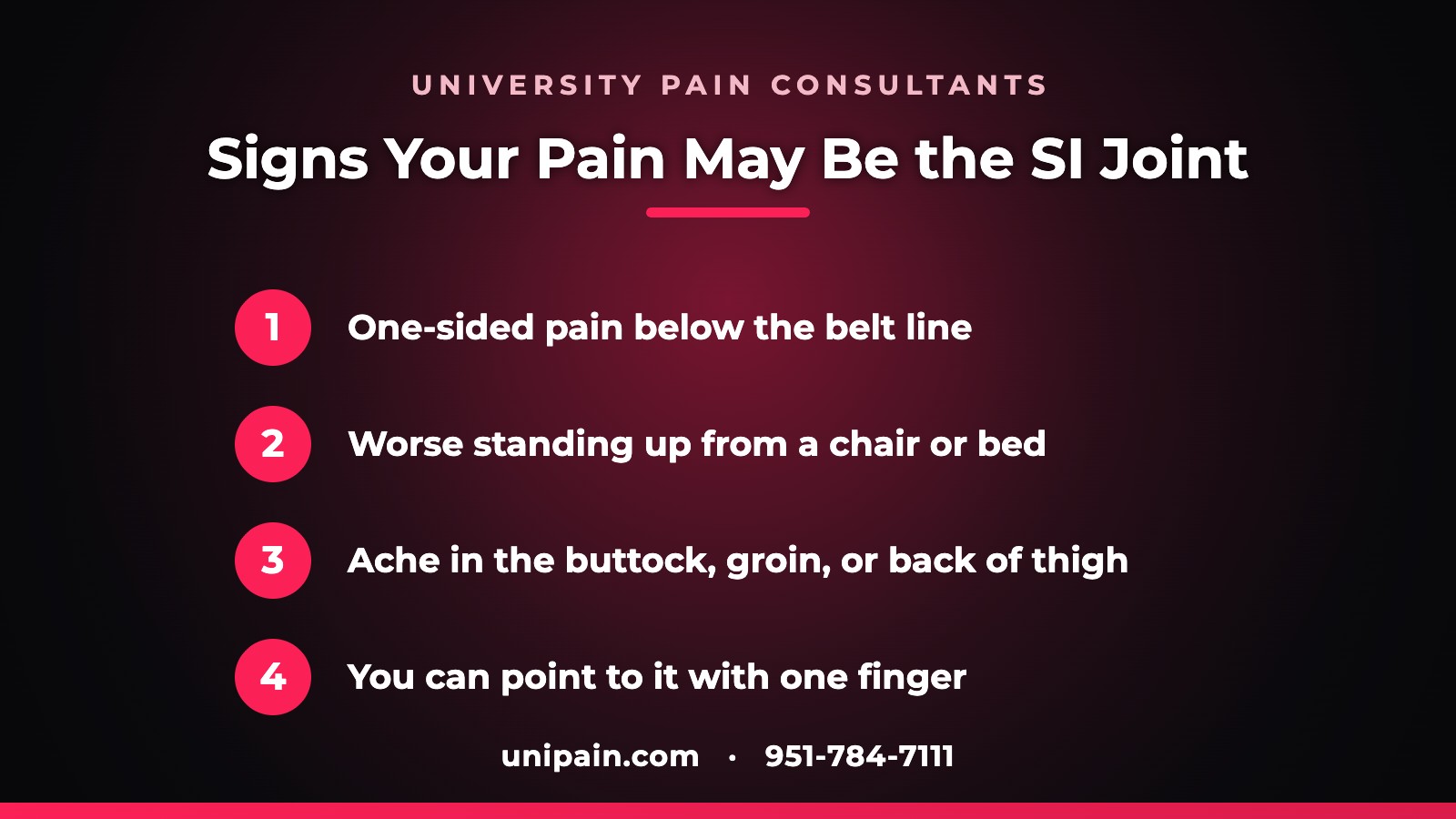
- Pain below the belt line, usually on one side, rather than centered in the spine
- A flare when standing up from a chair, rolling over in bed, or climbing stairs
- An ache that spreads into the buttock, groin, or back of the thigh
- A sore spot you can cover with one fingertip, just inside the dimple above the buttock
- Symptoms that started after pregnancy, a fall, or spinal fusion surgery
Referral patterns vary widely from person to person, though, and some patients feel pain all the way below the knee. That variability is exactly why the diagnosis cannot rest on symptoms alone.
SI joint pain, sciatica, and facet pain: how they differ
Because the sacroiliac joint sits at the crossroads of the spine, the pelvis, and the hip, its pain is routinely mistaken for something else. Sciatica from a compressed lumbar nerve root usually follows a defined path down the leg and brings numbness, tingling, or weakness in a specific distribution. SI joint pain more often stops in the buttock or upper thigh and comes without a true neurologic deficit. Facet joint pain tends to sit higher and closer to the midline and worsens when you lean backward or twist, while SI pain lives below the belt line and flares with single-leg loading, such as stepping up a curb or getting out of a car.
Hip arthritis adds another layer of confusion because it is classically felt in the groin and worsens with rotation, and the SI joint can refer to the groin as well. These distinctions shape the physical exam and the imaging we order, but overlap between them is common, and more than one pain generator can be active at the same time. That is precisely why a targeted diagnostic sacroiliac joint injection earns its place: it tests one structure at a time instead of asking you to guess.
Why an exam and an MRI cannot replace a sacroiliac joint injection
Imaging is far less decisive here than most people expect. When researchers reviewed pelvic CT scans of 373 adults with no back pain at all, 65% showed degenerative changes in the sacroiliac joints (Eno et al., Journal of Bone and Joint Surgery). Wear and tear on a scan simply does not prove that a joint is generating pain.
The physical exam helps, but only as a cluster. When three or more provocative maneuvers, such as distraction, compression, thigh thrust, Gaenslen’s test, and FABER, reproduce your familiar pain, suspicion rises considerably. No single test settles it. That is why a diagnostic sacroiliac joint injection is treated as the reference standard for confirming the SI joint as the source.
What happens during a fluoroscopically guided sacroiliac joint injection
A fluoroscopically guided sacroiliac joint injection is short and done while you are awake. You lie face down, the skin over the joint is cleaned and numbed with local anesthetic, and a C-arm fluoroscope is angled to open up the back of the joint on screen. A thin spinal needle is advanced into the lower portion of the joint under live imaging. A small amount of contrast dye, usually less than half a milliliter, is then injected.
That contrast step is the heart of the procedure. When the dye outlines the joint capsule and does not wash away into a blood vessel, we have visual proof the needle tip is inside the joint. Only then is the medication delivered, typically a long-acting local anesthetic combined with a corticosteroid. Total volume is kept small, around 2.5 mL or less, because the joint space itself is small.
Dr. Rainier Guiang walks through the anatomy and the procedure step by step in the video below.

Why fluoroscopic guidance changes the result of a sacroiliac joint injection
The sacroiliac joint is a narrow, irregular, C-shaped cleft buried under thick ligament and muscle. It cannot be felt reliably from the outside, and the published accuracy data make that plain. When investigators used CT to check where landmark-guided needles actually landed, only 22% were inside the joint, and 24% of the injections had spread into the epidural space instead. A separate study by an experienced injectionist put blind accuracy at 12%.

With fluoroscopy, intra-articular placement has been reported at roughly 98% (StatPearls, National Library of Medicine). That difference matters most for the diagnostic half of the test: if the numbing medicine never reached the joint, a negative result tells you nothing. A randomized trial in Mayo Clinic Proceedings found the clinical advantage of image guidance is modest at one month but significant at three months, so we are honest that fluoroscopy buys accuracy and confidence rather than a miracle.
What your response tells us, and what comes next
After a sacroiliac joint injection, keep a simple pain diary for the rest of the day. The local anesthetic works within minutes and wears off in a few hours, and that window is the diagnostic answer. Relief of at least 50% to 75% while the numbing medicine is active points strongly to the SI joint. The steroid works on a different clock, usually starting to help two to five days later after a possible day or two of soreness first.
If the block is positive and the steroid relief fades over time, the confirmed diagnosis opens the door to longer-lasting options: repeat injections, radiofrequency ablation of the nerves that carry sensation from the joint, which has produced sustained relief beyond six months in more than 60% of patients in published series, or minimally invasive SI joint fusion for carefully selected cases. If the block is negative, that is useful too, and we turn our attention to the facet joints, discs, or hip.
How long does relief from a sacroiliac joint injection last?
Published outcomes are encouraging but not uniform. In one series of patients with SI joint dysfunction, 67% had more than 50% pain reduction lasting beyond six weeks, and among those responders the average duration of relief was about 37 weeks. A practice audit of 155 patients reported a mean of roughly nine months of relief per injection. Systematic reviews grade the overall evidence as fair to moderate, so we set expectations individually rather than promising a number.
Is a sacroiliac joint injection safe?
Performed with image guidance, a sacroiliac joint injection is considered a low-risk outpatient procedure. The most common side effects are minor and temporary: soreness at the needle site, a brief flare of pain before the steroid takes effect, facial flushing, a short-lived rise in blood sugar for people with diabetes, and occasional lightheadedness. Infection, bleeding, and nerve irritation are rare. Some patients notice a few hours of leg heaviness from anesthetic spreading near a nerve, which resolves on its own.
Plan on being observed for 15 to 30 minutes afterward and having someone drive you home. Most people return to normal activity the next day. Tell us in advance about blood thinners, active infection, pregnancy, or a contrast allergy so we can plan around them.
Who is a good candidate, and who should wait
The best candidates have had pain for at least six to eight weeks, have already given conservative care a fair trial, and have a story and an exam that point below the belt line on one side. Conservative care usually means a course of physical therapy aimed at the hips and core, activity modification, and anti-inflammatory medication if your kidneys and stomach tolerate it. When those measures have not moved the needle, a diagnostic sacroiliac joint injection stops the guesswork.
There are good reasons to postpone. An active infection anywhere in the body, uncontrolled blood sugar, poorly controlled blood thinners, or a planned surgery in the coming weeks are all reasons to reschedule rather than push ahead. Pregnancy is a special case, since fluoroscopy uses ionizing radiation; ultrasound guidance is an alternative in that situation, though it confirms placement less definitively. If your pain is accompanied by fever, unexplained weight loss, new bowel or bladder changes, or progressive leg weakness, tell us immediately. Those are signals to investigate before injecting anything.
How to protect your SI joint between visits
An injection buys you a window. What you do inside that window determines how long the relief holds. The SI joint is stabilized by the muscles around your hips and trunk, so the most productive work is usually strengthening the gluteus medius and deep abdominal muscles and restoring hip mobility. A physical therapist who understands pelvic mechanics is worth more than any single exercise you find online.
A few practical habits help as well. Avoid standing with your weight parked on one leg, which loads a single SI joint for hours at a time. Sleep with a pillow between your knees to keep the pelvis level. Sit with both feet on the floor rather than cross-legged. If you have a true leg-length difference, a properly fitted heel lift can take asymmetric load off the joint. A sacroiliac support belt worn during flares gives some patients meaningful relief, though it is a short-term aid rather than a solution. Finally, if you smoke, understand that nicotine narrows the small vessels that feed spinal and pelvic tissues and slows healing after a sacroiliac joint injection.
Step by step: what your visit actually looks like
Most patients see us twice around the procedure. The first visit is an evaluation: a focused history, the provocative maneuvers described above, a review of any imaging you already have, and an honest conversation about whether a diagnostic sacroiliac joint injection is the right next step for you. If it is, we go over the risks, confirm your medication list, check for blood thinners and contrast allergies, and schedule the injection.
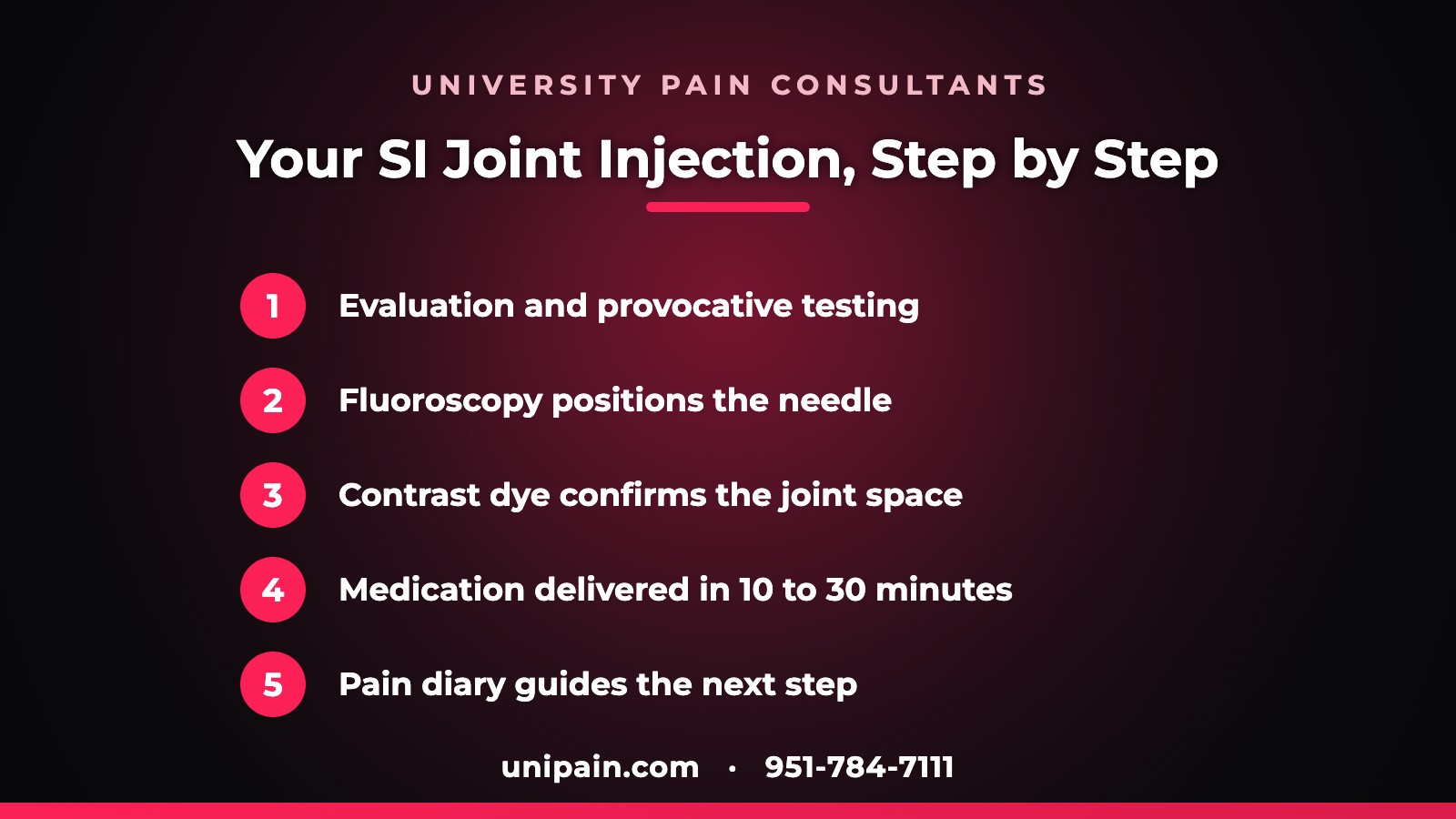
On procedure day, expect to be in and out in about an hour from check-in to discharge, with only 10 to 30 minutes of that spent in the procedure room. You will leave with written aftercare instructions and a simple pain diary, and we ask you to record your pain hourly for the rest of the day. At the follow-up visit we compare those numbers against your baseline, decide whether the sacroiliac joint is confirmed as the pain generator, and build the next step of your treatment plan around that answer rather than around a guess.
That last point is worth emphasizing. A sacroiliac joint injection that does not help is not a wasted procedure. Ruling the SI joint out is genuinely useful information, and it keeps you from spending months and money chasing the wrong structure.
What a sacroiliac joint injection can and cannot do
It is worth being clear about the limits. A sacroiliac joint injection is a diagnostic and symptom-control tool, not a cure. It does not reverse arthritis inside the joint, tighten stretched ligaments, or correct a mechanical problem such as a leg-length difference. What it does is quiet inflammation in one specific joint long enough for you to move better, sleep better, and get real value out of physical therapy, which is where durable improvement usually comes from.
Corticosteroid is also not something to repeat indefinitely. Cumulative steroid exposure can affect blood sugar, bone density, and cartilage over time, which is why we space injections out and start looking for a longer-lasting answer when someone needs them often. If a well-placed sacroiliac joint injection reliably takes your pain away but the relief keeps fading, that is not a failure. It is a confirmed diagnosis, and it is the strongest argument there is for moving on to radiofrequency ablation or, in carefully selected patients, minimally invasive fusion.
Frequently asked questions
How long does a sacroiliac joint injection take?
The injection itself usually takes 10 to 30 minutes. You are awake the whole time, and the skin and deeper tissues are numbed first, so most patients describe pressure rather than sharp pain.
Does a sacroiliac joint injection hurt?
Most people rate the discomfort as mild. The stinging of the numbing medicine is the worst part for many patients. Light sedation is available if you are anxious, though it can blur the diagnostic value of the test.
Can I have the injection without X-ray guidance?
It is possible, but a blind sacroiliac joint injection lands inside the joint only 12% to 22% of the time. Because the diagnostic value depends entirely on the medication reaching the joint, we do not perform them without fluoroscopy.
How many injections can I have?
There is no universal limit, but a repeat sacroiliac joint injection with steroid is generally spaced out and capped at a few per year to limit steroid exposure. If you need them frequently, that is usually the signal to discuss a longer-lasting option such as radiofrequency ablation.
What should I do the day of the procedure?
Before a sacroiliac joint injection, eat lightly, take your usual medications unless told otherwise, wear loose clothing, and bring a driver. Afterward, avoid strenuous activity for 24 hours and keep track of your pain scores hour by hour so we can interpret the block accurately.
If one-sided low back and buttock pain has been dismissed as generic back pain, a properly performed sacroiliac joint injection can finally answer the question. Dr. Rainier Guiang, MD and the team at University Pain Consultants evaluate and treat SI joint pain at our Riverside office. Learn more about the conditions we treat, read our related article on smoking and degenerative disc and joint disease, or contact our office at 951-784-7111 to schedule an evaluation.

Rainier Guiang, MD
Dr. Rainier Guiang co-founded University Pain Consultants in 2007 and is double board-certified in anesthesiology and pain management through the American Board of Anesthesiology. He previously served as co-director of the ACGME-accredited pain management fellowship at University Hospitals of Cleveland / Case Western Reserve University School of Medicine, and has authored chapters in Weiner’s Pain Management. He has a strong interest in interventional, functional, and preventive approaches to chronic pain.